



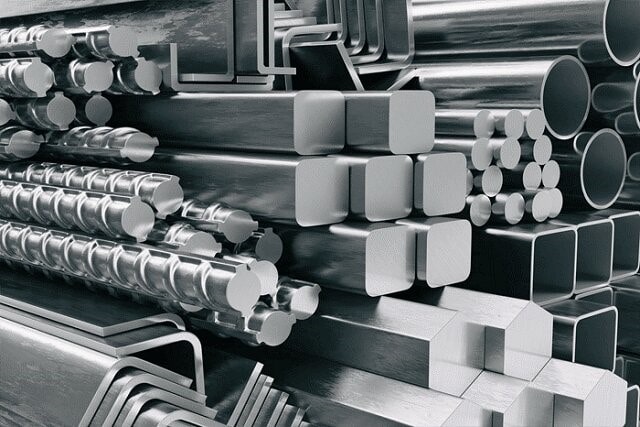
In today’s world, traces of steel structures can be seen everywhere. From buildings to the transportation sector, etc., all are made of iron and steel in some way. Among them, there is a special type of steel that is called structural steel due to its extensive use in construction. That is why the price of iron tools Construction is very important for engineers and designers and they always try to be aware of the current prices of these sections. All steel sections such as rebar, beam, angle, gutter, etc. are a type of structural steel section that is produced from structural steel. They have become .
?What is structural steel
Structural steel is a type of steel used as a building material in various grades and shapes. These steels are designed to have a good strength-to-weight ratio and are cost-effective to be used as a structural component in buildings, roads, bridges, etc. These types of steels can be formed in a variety of ways, such as casting, hot rolling, cold rolling, bending, etc. They produced .
Types of structural steel
Structural steel comes in different grades and shapes. It is very important to pay attention to the steel grade . Because each grade is used for a specific application and another section cannot be substituted for it unless an equivalent standard is specified for it. For example, black steel sheets are available in two common grades, St37 and St52 , where St37 is a structural grade and St52 is an industrial grade .
Structural steel grades
The grade or class of steel is determined based on the chemical composition and unique properties of each steel . Types of structural steel grades include :
- Carbon steels
- High strength low alloy steels
- Forged steels
- Quench and temper steels
Carbon steels
Carbon steel is a category of structural steels that have very few or no alloying elements in their chemical composition. Carbon steels are divided into low-carbon (less than 0.3 percent), medium-carbon (between 0.3 and 0.6 percent), high-carbon (0.6 to 1 percent), and ultra-high-carbon (between 1 and 2 percent) types of steels based on the amount of carbon they contain. This category of structural steels plays the largest role in the production of steel sections, and as a result, the price of these sections, including the price of rebar , beams, sheets, etc., depends on the current price of these steels .
High strength low alloy steels
These types of steels are designed to have better mechanical properties and are more resistant to corrosion than carbon steels. They contain about 2% manganese along with small amounts of other alloying elements such as chromium, nickel, molybdenum, nitrogen, vanadium, niobium and titanium. Weathering steels or Corten steels (Cor-Ten) are one of the most important structural steels, which are a subgroup of high-strength low-alloy steels and exhibit high resistance to atmospheric corrosion by forming a passive surface layer .
Forged steels
Forged steel is a type of structural steel that is formed into a desired shape by hammering or applying pressure. Forged steel is usually stronger and more durable than other types of steel, such as cast steel or rolled steel. Forging is done by heating steel to a high temperature and applying pressure. In this process, mechanical and thermal energy is applied to a steel ingot or billet. The pressure causes the steel to deform and flow into the desired shape. Forged steel is often used to produce gears, bearings, shafts, hinges, valves, and other components .
Quenched and tempered steels
Quenched and tempered structural steels are a type of steel that has undergone a heat treatment process. This process gives the steel greater strength, hardness, and toughness. Quenching involves heating the steel to a high temperature and then rapidly cooling it in a cooling medium such as water, oil, or brine. This creates a hard martensitic microstructure in the steel .
Tempering involves reheating quenched steel to a lower temperature and then slowly cooling it. This process softens the martensitic microstructure, making the steel more ductile. Quenched and tempered structural steels are commonly used in construction, shafts, and bolts .
Structural steel shapes
Structural steels are available in the market in various forms that are selected and purchased based on the type of structure. In fact, every type of steel section you know falls into this category in some way .
The most important forms of structural steel are :
- Plain and ribbed steel rebars
- Steel beams, trusses, and honeycomb beams
- Types of sheets include black, oiled, acid-washed, galvanized and colored sheets.
- Steel corner, gutter and shield
- Types of steel cans and profiles
- Structural steel pipes and tubes
Applications of structural steel
steel is used in a variety of applications, including :
- Construction : Structural steel is the backbone of many modern buildings, from skyscrapers to homes. Sections made from structural steel are used to create frames that support the weight of walls, floors, and roofs .
- Bridge construction : Structural steel is also used to build long span bridges. These steels are strong enough to support the weight of vehicles and pedestrians and can also withstand forces from environmental factors .
- Building towers : Structural steel is used to build towers such as telecommunications towers and wind turbines. These towers must be able to withstand high winds and other weather conditions .
- Other structures : Structural steel is also used in a variety of other structures, such as building warehouses, stadiums, and industrial plants
Khaf Makran International Trading Company
+989155795464
Address: floor Ground level, Next to Sina Alley 18, Sina avenue KHAF city, Khorasan Razavi province IRAN
Postal Code: 9561881834